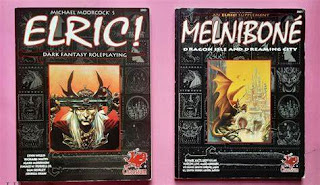
The last time I posted on this poor, neglected blog was in August 2023, and a lot has happened since then - I've been meaning to blog about it for ages, but time got away from me. So, consider this post a quick catch-up on some of the creative work I've been doing over the last 12 months or so. I say quick, but given I'm an all or nothing kinda of guy, let's see how long I write for this evening and how much detail I go into, shall we? Last year, starting on Friday June 8th and continuing on over the weekend, I was a Guest of Honour at the innaugural Chaosium Con Australia ; a celebration of the games published by Chaosium Inc , a company whose work I've long admired and was once a regular contributor to, especially their game of Lovecraftian cosmic horror, Call of Cthulhu , which I first encountered in 1984; I also contributed significantly to Chaosium's Stormbringer and Elric! game lines, roleplaying games based on the work of enormously influential Englis...
The long-awaited film adaptation of Jack Kerouac’s ground-breaking novel presents the perfect opportunity to re-examine the lives of the Beat Generation, writes Richard Watts. It’s not hyperbole to say that the Beat Generation – a small coterie of writers who met up in New York City in the spring of 1944 – changed the world. Without their individual quests for personal freedoms – a quest for sex and drugs before there was rock and roll; a quest which spawned the western world’s first counter-culture, the beatniks – the hippy movement of the Sixties would never have happened, and punk would have been a quiet snarl rather than a global reaction. Of all the Beat Generation writers, Jack Kerouac, author of the autobiographical beatnik bible, On the Road , is unequivocally the most famous. Born in Lowell, Massachusetts in 1922, to working class French-Canadian parents, Kerouac aspired to be a writer from a young age, though he was also a keen football player. Indeed, it ...
I've lived in Fitzroy for 14 years, and long before I moved here spent some formative moment in its pubs and terrace houses. I have an unpublished novel that set's in Fitzroy in the 1940s (originally it was set in the 1950s but I've realised it was the wrong period). I love this suburb, even as it changes before my eyes, which is why I love articles and photographs and stories of its past. From the Herald-Sun , here's a series of images of the old inner city slums that once characterised much of Fitzroy. And from The Age just yesterday, here's an article about a photographer who was documenting the vanishing post-war Fitzroy culture in 1973-74. Happy reading. And maybe allow Dan Sultan to provide you with a soundtrack?


Comments